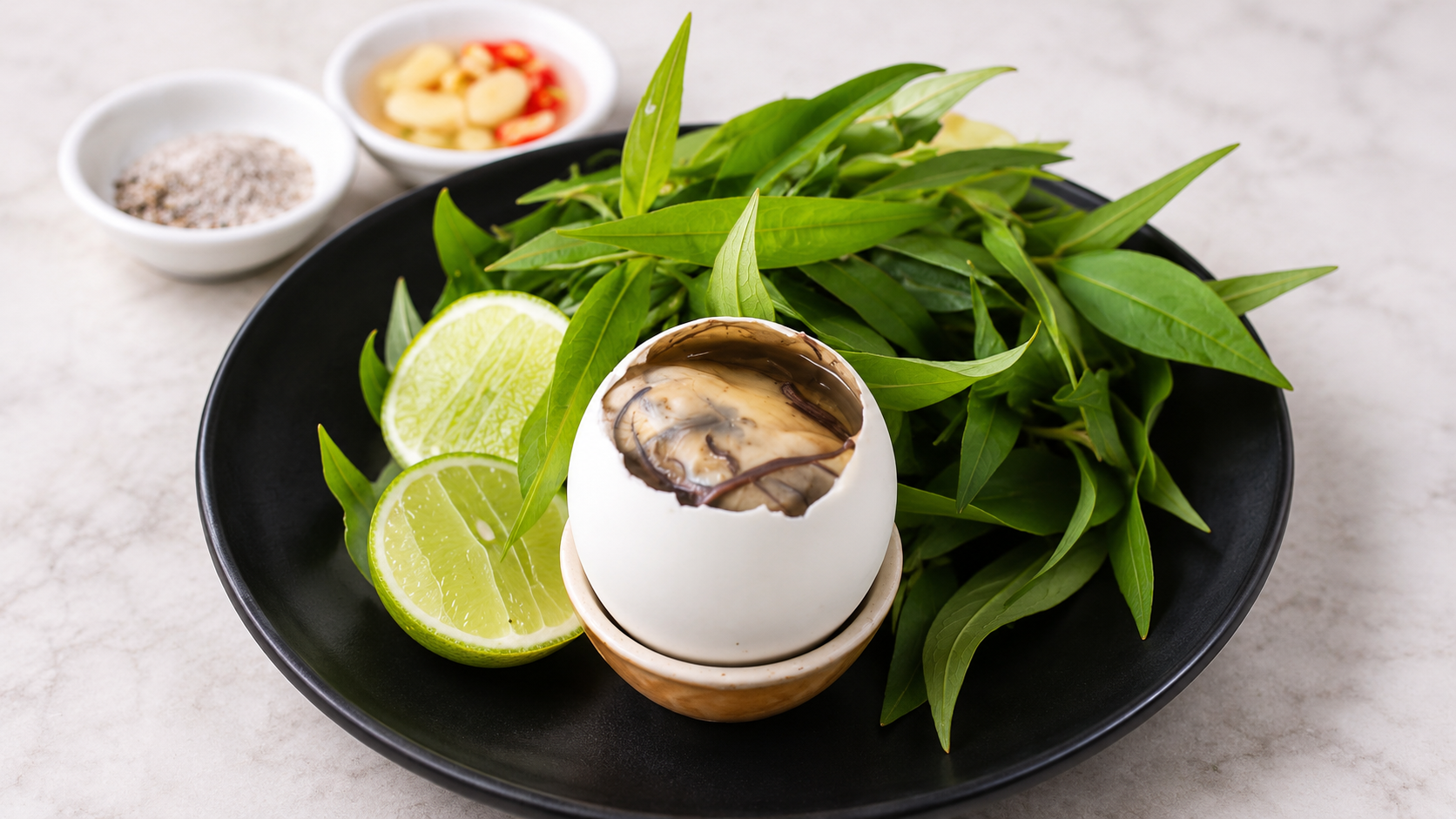
요약: 발롯은 부화 직전의 오리알을 삶아서 껍질째 먹는 요리로, 캄보디아에서 인기 있는 길거리 음식입니다. 이 요리는 소금, 식초 등을 곁들여 먹으며, 부화 직전의 알의 특유한 질감과 맛을 즐깁니다.
설명: 뜨거운 물에 삶았다가 찬물을 부어 식혀 비린내를 날린 후 먹는다. ‘찌 니응 봉’ 이라고 하는 향채와 후추소스, 마늘소스와 곁들여 맥주나 사탕수수 음료등과 함께 먹는다.
‘뽕 띠어 꼬은’은 성장하다가 만 오리의 태아가 들어있는 오리알을 뜻한다. 겉에서 보면 일반 삶은 계란과 다를 바 없지만 껍질을 까 보면 껍질 속에는 성장하다 만 오리의 태아가 그대로 있는 것을 볼 수 있으며 고단백 식품으로 알려져 있다. 또한 캄보디아인들의 에너지 공급원이자 활력 충전에 좋은 음식으로 믿고 먹는다. 캄보디아의 청소년이나 젊은이들 사이에서도 ‘뽕 띠어 꼬은’은 인기 만점의 간식이지만 몸을 뜨겁게 해서 여드름을 많이 나게 하기 때문에 연애 중의 여성들은 금하기도 하며 너무 많이 먹으면 설사를 유발한다고도 한다. 캄보디아에서는 오리알 속의 오리 태아의 크기나 성장 정도에 따라 두 종류로 나누는데, 하나는 작은 새끼를 뜻하는 '꼬은 또으잇' 다른 하나는 큰 새끼를 뜻하는 ‘꼬은 톰’이다. 이 중 작은 새끼인 ‘꼬은 또으잊’이 대부분의 캄보디아 사람들이 즐겨 먹는 종류이며 약 17일 정도 성장시킨 것으로 아직 뼈마디와 깃털이 많지 않다. 한편 성장한지 20일 정도 된 ‘꼬은 톰’을 좋아하는 사람들도 있다. ‘꼬은 톰’에는 부리, 깃털, 발톱 등이 자라있어 좀더 이질감이 들고 먹다보면 이빨 사이에 끼기도 하고 뼈가 씹히기도 한다.
재료: 오리알, 소금, 식초
조리법: 부화 직전의 오리알을 삶아서 껍질째 제공
문화적 의미: 발롯은 캄보디아, 필리핀, 베트남 등 동남아시아 여러 나라에서 즐겨 먹는 길거리 음식으로, 고단백질 식품으로 알려져 있습니다.
제목: Balut
요약: Balut is a dish made from a nearly hatched fertilized duck egg, which is boiled and eaten whole in its shell. It is a popular street food in Cambodia, the Philippines, and Vietnam.
재료: Fertilized duck egg, water, salt, vinegar
조리법: The eggs are boiled until the embryo inside is fully cooked, preserving the unique texture and flavor.
문화적 의미: Balut is a controversial delicacy, often considered a high-protein food. It is commonly sold as street food and is part of the local culinary tradition in Cambodia.
사용자 입력 정보
음식명: ពងទាកូន
키워드: 캄보디아 음식
메모: 캄보디아 식당의 메뉴판에 있는 음식
기본 정보
Slug: ពងទាកូន
등록일: 2026-11-01 04:18:22
마지막 업데이트: 2026-11-01 18:34:02
추정 원산지:
캄보디아 (Cambodia) · KHM
추정 언어: km
소스: llm
📚 AI가 참고한 관련 정보
AI가 정보를 생성하기 위해 수집하고 분석한 자료들입니다.
KM 언어 자료
(총 3개)
▼
1. Balut (food) - Wikipedia
검색 결과 미리보기:
It is commonly sold as street food in Southeast Asia, most notably in the Philippines, Cambodia (Khmer: ពងទាកូន, romanized: paung tea kaun ), and Vietnam ...
3. Cambodian balut egg: the most controversial delicacy ever?
검색 결과 미리보기:
Apr 10, 2021 ... A balut egg is a fertilized bird egg. You will mainly find balut duck eggs. Duck eggs are a bit larger than chicken eggs. The eggs are first ...
검색 결과 미리보기:
Balut ( bə-LOOT, BAH-loot; also spelled as balot) is a fertilized developing egg embryo that is boiled or steamed and eaten from the shell. It is commonly sold as street food in Southeast Asia, most notably in the Philippines, Cambodia (Khmer: ពងទាកូន, romanized: paung tea kaun), and Vietnam (Vietnamese: trứng vịt lộn, hột vịt lộn), and also occasionally in Thailand (Thai: ไข่ข้าว, romanized: khai khao). Balut is often seasoned with salt and vinegar.
The length of incubation before the egg is c
Balut ( bə-LOOT, BAH-loot; also spelled as balot) is a fertilized developing egg embryo that is boiled or steamed and eaten from the shell. It is commonly sold as street food in Southeast Asia, most notably in the Philippines, Cambodia (Khmer: ពងទាកូន, romanized: paung tea kaun), and Vietnam (Vietnamese: trứng vịt lộn, hột vịt lộn), and also occasionally in Thailand (Thai: ไข่ข้าว, romanized: khai khao). Balut is often seasoned with salt and vinegar.
The length of incubation before the egg is cooked is a matter of local preference, but generally ranges from two to three weeks. Balut can cause vomiting if not cooked correctly.
Description
A balut is a fertilized bird egg (usually a duck) that is incubated for a period of 14 to 21 days, depending on the local culture, and then steamed. The contents are eaten directly from the shell. Balut that is incubated for longer periods have a well-developed embryo and the features of the duckling are recognizable. The partially developed embryo bones are soft enough to chew and swallow as a whole. The mallard duck (Anas platyrhynchus), also known as the "Pateros duck", is often used to make balut. Balut is a renowned dish due to its different developmental stages; some people prefer it when the duck embryo is still largely liquid, while others prefer it when it is more mature and has a chewier texture. A combination of savory, gamey, and rich characteristics can be found in the flavor, which makes it an acquired taste that many Filipinos treasure as a culinary treat and a part of their culture.
Balut is common street food in the Philippines, Vietnam, and other localities, and is also sold in stores and malls. It is a relatively cheap source of protein and calcium. Balut was introduced to the Philippines by the Chinese in 1565, and since then balut has been included as a traditional part of the culture. Wherever Filipinos migrated for work, a large market for balut would develop. Controversies arose as knowledge of the food spread around the Southeast Asian countries and then globally. People have questioned the ethics of eating balut. Ethical concerns are most often attributed to the presence of a fertilized embryo within the dish, given the fact that the egg has not yet hatched nor been given the chance to hatch. There are also ethical concerns as to whether the embryos can feel pain at the stages balut tends to be boiled.
Preparation
Traditionally, the fertilized eggs are incubated in the sun or buried in sand and stored in baskets to retain warmth. In order for the embryo to develop normally, it must be exposed to heat for the correct period of time while ensuring that the temperature is not too hot to harm the eggs or too cold to permit growth. The embryo is extremely sensitive to high temperatures and is easily killed upon cooking in the sun. Within the first few stages of maturation, balut is known as "balut sa puti" ("wrapped in white") when it is white; the embryo inside is insufficiently developed to show a beak, feathers, or claws, and the bones are undeveloped. These are made from very specific egg types, less than five days old and with no visible surface cracks.
The duration of egg incubation is a matter of local preference. In the Philippines, balut is generally incubated for 14 to 18 days before being boiled for consumption. At about 14 to 16 days of incubation, the embryo floats on top of the egg white and yolk, and the balut is called "mamatong". For most balut makers, the ideal incubation is said to be 17 days old.
There are other versions of balut. In the Cambodian version, pong tea khon, the egg is incubated for 18 to 20 days. In the Vietnamese version, trứng vịt lộn, the egg is incubated for 19 to 21 days, when the embryo is old enough to be recognizable as a baby duck and has bones that will be firm but tender when cooked. Some men prefer to eat an embryo that is much more developed, "...so that it looks gross, because that is a way to prove your manhood."
Chemistry of cooking
During this cooking process, changes occur in the food chemistry of balut, such as the sol dispersion of water molecules within the embryonic fluid. This liquid becomes the broth for the solid which are parts of the duck within the egg. After cooking, it can be considered a protein gel, depending on the length of time it was cooked. Heating high-protein food such as balut can cause the chemical changes to take place and fully or partially denature proteins, causing the surface to become thick and causing an irreversible gel protein to form.
Temperature has a significant impact on the final taste and texture of the cooked balut. Warm temperatures of 29–30 °C (84–86 °F) change the taste and texture of the yolk by making it more grainy. This can be attributed to the changes in proteins, and their partial denaturation, during the heating and incubation process. When boiling or cooking eggs, the white of the egg tends to solidify because the proteins are denatured in an irreversible reaction and turn from transparent to an opaque white. Physical and chemical changes in the final balut product can also be attributed to microbial infections and the rate that microbes infect the balut at various stages.
There are many chemical changes that occur inside the duck egg as it is being processed, which can vary depending on how or what it is cooked with. While boiling, added salt can contribute to a number of chemical changes; it seems to increase the proportional weight of egg white within the shell, which can be due to the weight differences between the embryo and the egg white itself. Added salt can also increase the hardness of the egg yolk and affect the overall texture of the final balut product. Other chemical changes observed in nutrient content of the duck egg as it is processed are a slight decrease in the amount of available amino acids, water-soluble vitamins, and minerals after the processing is complete.
Nutrition
There are different nutritional values for balut, since it can be either fertilized chicken or duck eggs. Balut nutrition specifications between chicken and duck have minor differences, but both eggs have around 14 grams of crude protein, 188 calories each, and around 100 milligrams of calcium. A duck egg might have a higher value of nutrition than a chicken egg, but overall, both chicken and duck balut have approximately the same nutritional value.
In folk medicine, according to popular Vietnamese belief, these eggs are nutritious and restorative food for pregnant or delivering women.
Dishes and vending
Balut eggs are savored for their balance of textures and flavors. The broth surrounding the embryo is often sipped from the egg before the shell is peeled, then the yolk and young chick inside can be eaten. All of the contents of the egg may be consumed, although the white albumen may remain uneaten, depending on the age of the fertilized egg. This white albumen may have an unappetizing cartilaginous taste and is tough and rubbery in texture.
In the Philippines, balut has recently entered haute cuisine by being served as appetizers in restaurants, cooked adobo style, fried in omelettes, or even used as filling in baked pastries. In Vietnam, balut is eaten with a pinch of pepper salt with lime/kumquat or ginger and rau răm (also known as laksa leaf). The dish "trứng vịt lộn" can be served as boiled balut or grilled balut. In Cambodia, balut is eaten while still warm in the shell and served with nothing more than a little garnish, which is usually a mixture of lime juice and ground pepper.
A similar preparation is known in China as maodan (Chinese: 毛蛋; pinyin: máo dàn; lit. 'feathered egg'), modan (Chinese: 末蛋; pinyin: mò dàn; lit. 'end-stage egg'), wangjidan (Chinese: 旺雞蛋; pinyin: wàng jīdàn; lit. 'flush egg'), or huozhuzi (Chinese: 活珠子; pinyin: huózhūzi; lit. 'living bead'). Chinese traders and migrants are said to have brought the idea of eating fertilized duck eggs to the Philippines; however, the knowle
KO 언어 자료
(총 1개)
▼
1. 발룻 - Wikipedia ✓ 본문수집
검색 결과 미리보기:
발룻(Balut)은 부화 직전의 오리알을 삶은 요리이다. 필리핀, 중국, 캄보디아, 베트남 등에서 즐겨 먹는다.
베트남에서는 쯩빗론(trứng vịt lộn) 또는 홋빗론(hột vịt lộn)이라고도 한다. 부화 직전의 알을 삶았기 때문에 혐오식품처럼 보이기도 하지만, 고단백 식품으로 정력에 좋다고 알려져 있기도 하다.
준비 과정
필리핀에서는 주로 발룻을 소금, 칠리소스, 마늘이나 식초를 곁들여서 먹는다. 발룻은 부화 직전의 알 요리로 삶은 오리를 통째로 먹는 것으로 그 특유의 누린내와 질감을 즐기는 사람들도 많다. 발룻은 껍질을 제외한 모든 부분을 먹는다.
같이 보기
곤계란
각주
외부 링크
위키미디어 공용에 발룻 관련 미디어 분류가 있습니다.
〈발룻〉. 《두산세계대백과사전》. (주)두산.
보신탕과 발룻은 민족 고유의 맛일 뿐이다 - 오마이뉴스