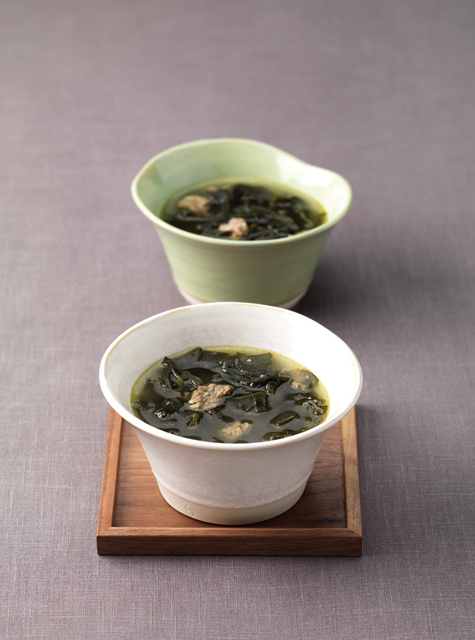
Hello! Today, in celebration of Editor S’s birthday—the person writing this article—we would like to share the story of miyeokguk, a dish that never fails to appear on a Korean birthday table.
At the heart of a Korean birthday meal, there is always a bowl of miyeokguk. More than just a warm seaweed soup, it carries deep meaning—symbolizing a mother’s love and heartfelt wishes for a fresh new beginning.
In Korea, the tradition of eating miyeokguk (seaweed soup) on birthdays is said to date back to the Goryeo period. One popular story explains that people began feeding seaweed to mothers after childbirth after observing mother whales eating seaweed to recover after giving birth.
Through experience, Koreans came to believe that seaweed was highly beneficial for postpartum recovery, helping restore strength and support milk production. As a result, mothers traditionally ate miyeokguk after giving birth.
Over time, this custom evolved into a birthday ritual: children eat miyeokguk on their birthdays as a way of expressing gratitude for their mother’s effort and love, while wishing for health and growth in the year ahead. Today, miyeokguk represents more than just a birthday dish—it has become a cultural symbol that honors maternal care and celebrates new beginnings.
Interestingly, however, there is one day when miyeokguk is often avoided: important exam days. Because of the soup’s slippery texture, a long-standing Korean superstition suggests that eating miyeokguk might cause someone to “slip” on an exam, meaning to fail. While it symbolizes the joy of birth on birthdays, it becomes a food to avoid on test days—reflecting the playful duality found within Korean food culture.

In Korea, it has long been a tradition for new mothers to eat miyeokguk as part of postpartum recovery. Seaweed is especially recommended after childbirth because of its rich nutritional value.
Often called “the vegetable of the sea,” seaweed contains abundant minerals and vitamins.
It is particularly high in iodine, an essential nutrient for thyroid hormone production that plays an important role in fetal brain development and growth. Seaweed is also rich in calcium, which helps support bone health in mothers and contributes to the development of a baby’s skeletal system, while its iron content can help prevent anemia during pregnancy.
In addition, alginic acid—the naturally slippery compound found in seaweed—helps bind and remove heavy metals and waste from the body, supporting blood circulation and aiding digestion by promoting healthy bowel movement.
For these reasons, seaweed has long been considered a natural restorative food in Korea, believed to support uterine recovery, help with postpartum healing, and provide essential nourishment for pregnant and breastfeeding mothers.
Unlike many other Korean soups, miyeokguk is typically prepared without green onions. This is because certain sulfur compounds and phosphorus found in green onions are believed to interfere with calcium absorption and can overpower the soup’s clean, delicate flavor.
While seaweed soup is considered a nourishing and restorative dish—especially for new mothers—it contains very high levels of iodine. For individuals with thyroid-related conditions, it is recommended to moderate intake and consult dietary guidance when consuming miyeokguk.
While seaweed is the foundation of miyeok-guk, the choice of additional ingredients creates countless flavor variations.
The most common version, beef miyeok-guk, is made by stir-frying beef and soaked seaweed in sesame oil, producing a deep, savory broth that makes for a satisfying meal.
The umami-rich beef pairs beautifully with the clean, oceanic flavor of seaweed, making it one of the most beloved combinations in Korean cuisine.
For those who prefer a stronger taste of the sea, mussel miyeok-guk or abalone miyeok-guk are excellent choices.
Mussels add a refreshing, clean depth, while abalone contributes a firm texture and refined umami, making it ideal for special occasions.
Clams or oysters are also commonly used, each adding their own distinct character to the soup.
Modern adaptations continue to expand miyeok-guk’s possibilities.
Tuna miyeok-guk, made with canned tuna, offers convenience along with a rich, savory flavor. Bone-broth miyeok-guk, simmered in beef bone stock, delivers a deeper, more robust taste and is often associated with restoring energy and supporting bone health.
For those focused on diet and wellness, chicken breast miyeok-guk provides a low-calorie, high-protein alternative with a clean, comforting broth. Through these variations, miyeok-guk continues to evolve while staying true to its roots.
If you want to recreate the comforting taste of Korean home-style miyeokguk, remember these two essentials:
1. The Art of Sautéing
When cooking the soup, sauté the beef and soaked seaweed in sesame oil long enough for the seaweed to turn a soft green. This step helps remove any ocean-like smell and allows the broth to develop a richer, milky depth of flavor.
2. Choosing the Right Soy Sauce
Instead of regular soy sauce, use traditional Korean soup soy sauce (guk-ganjang). It enhances umami without darkening the broth too much. Adding a small spoonful of fish sauce can further deepen the savory flavor, much like the taste found in well-known Korean restaurants.

Personally, I love miyeok-guk so much that I cook it even when it isn’t my birthday.
To be honest, what I enjoy most isn’t just the soup itself, but the seaweed(Miyeok) inside it.
I love the tender, silky strands of miyeok so much that it wouldn’t be an exaggeration to say I eat miyeok-guk mainly for the seaweed.
On days like today, when icy winds blow and temperatures drop to minus seven degrees Celsius, a warm bowl of miyeok-guk feels especially comforting.
With each sip of its savory broth and each bite of tender seaweed and protein-rich ingredients, the chill slowly melts away.
Miyeok-guk is not merely food—it is a living heritage that carries Korean emotion and culture. It celebrates birthdays, blesses new life, and offers quiet comfort on difficult days.
Even if today isn’t your birthday, on a cold day like this, I hope a bowl of miyeok-guk warms both your body and heart—and fills your day with health and happiness.