When I was a child, I remember my mother waking up before dawn to make gimbap whenever we went on a school picnic.
The smell of gimbap being rolled would gently pull me from sleep, and as I sat beside her rubbing my eyes, she would cut off a piece of freshly made gimbap and place it in my mouth. Chewing slowly, I would fully wake up and get ready for the day. In this way, gimbap has remained a food closely tied to small, cherished memories for many Koreans.
During my school years, it was something I often picked up at snack shops near school; as an adult, it naturally became a go-to meal for travel days, commutes, or busy lunches. It may not be reserved for special occasions, yet somehow gimbap has always been present during meaningful moments.
In recent years, frozen gimbap distributed overseas and the influence of K-Pop Demon Hunters have helped turn gimbap into a dish that people around the world want to try at least once. This article explores the origins and evolution of gimbap, its differences from Japanese norimaki, and the many forms it has taken—revealing how a familiar everyday food in Korea has grown into a global cultural curiosity.

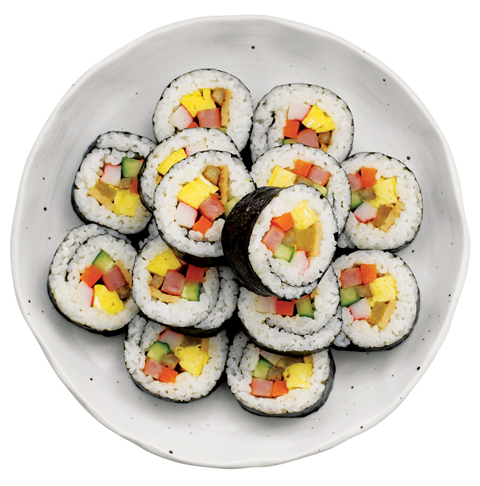
Gimbap is a rolled dish made by wrapping rice in dried seaweed, filling it with a variety of ingredients, and slicing it into bite-sized pieces. At its core are two essential elements: rice and seaweed. The rice is seasoned simply with sesame oil, salt, and sesame seeds, yet this combination alone creates gimbap’s signature nutty aroma.
The most common style of gimbap uses this seasoned rice along with fillings such as carrots, spinach, egg strips, ham, pickled radish, and burdock root. Each ingredient is prepared or lightly seasoned in advance, then arranged neatly on the seaweed with the rice before being rolled tightly without gaps. The finished roll is typically cut into easy-to-eat pieces, lightly brushed with sesame oil, and sprinkled with sesame seeds to enhance its flavor.
Not all gimbap, however, is filled with a wide variety of ingredients. A simpler style—rice wrapped only in seaweed—has existed for a long time. A familiar example is wrapping a spoonful of rice in a small sheet of seasoned seaweed. In this form, the focus shifts away from elaborate fillings toward the direct contrast between the savory seaweed and the nutty rice itself.
This minimalist approach emphasizes convenience and the pure taste of the ingredients. In this way, gimbap remains a remarkably versatile food, capable of endless variations depending on the combination of ingredients and preparation methods.
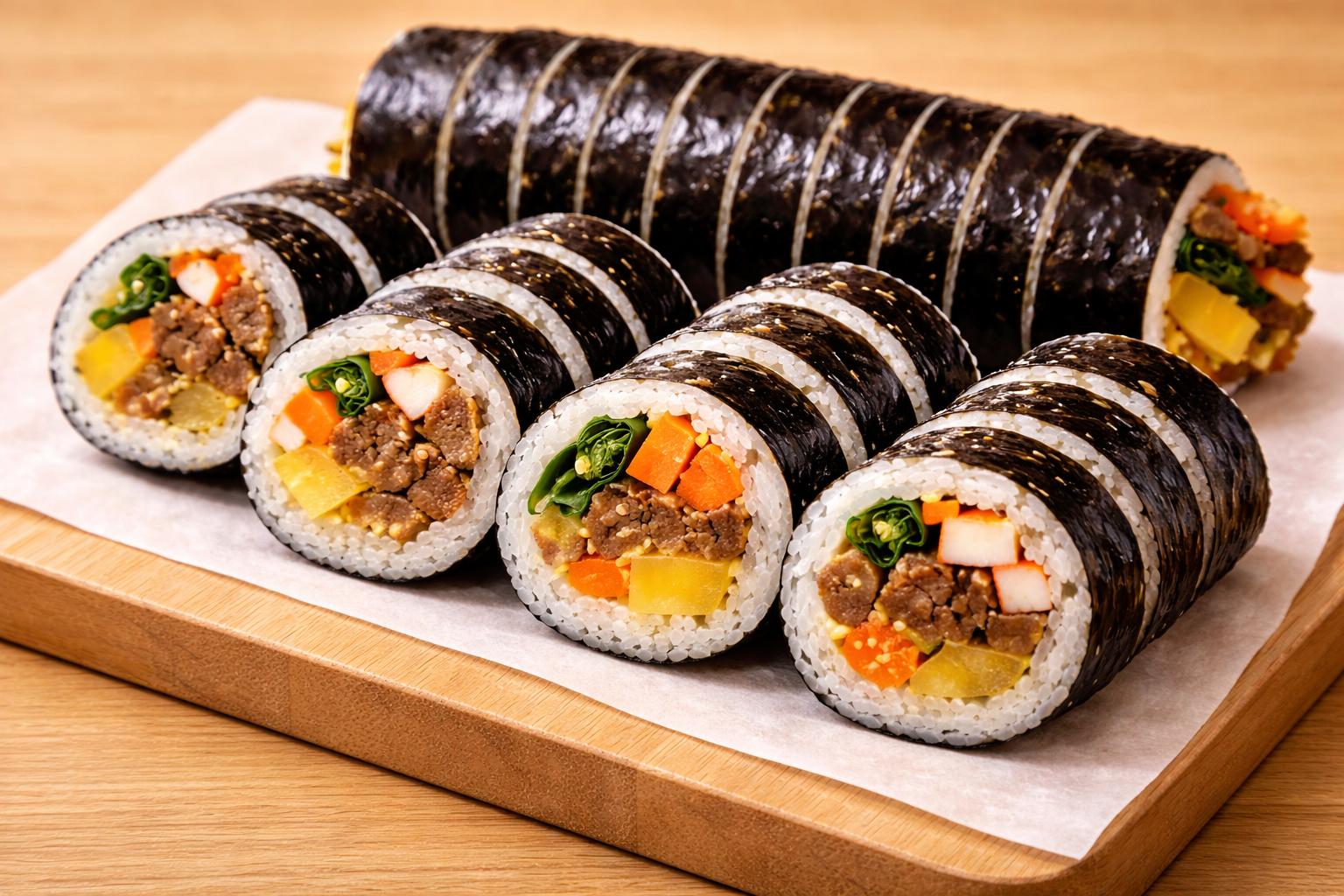
What are the origins of the gimbap we know today? While some suggest that it evolved from Japan’s norimaki, historical records indicate that the practice of wrapping rice in seaweed or leaves existed in Korea long before the modern form of gimbap appeared.
As early as the Silla period, it is said that people enjoyed a custom called boksam (or bokgwa), in which glutinous rice was wrapped in cabbage leaves or seaweed during the Lunar New Year’s first full moon festival, Jeongwol Daeboreum. Today, the holiday is often associated with eating assorted vegetables and cracking nuts for good fortune, but historical texts such as Dongguk Sesigi and Yeolyang Sesigi describe a tradition of wrapping rice in leafy greens or seaweed while wishing for prosperity in the coming year. Rather than being a simple meal, this practice carried a ritualistic meaning that connected seasonal change with community life.
Depending on the region, this custom was known by various names, including “wrapping rice in seaweed,” beotseom, or beotseom kkureongi. In some areas, there was even a belief that breakfast should be eaten wrapped in seaweed, and people avoided cutting the seaweed with knives or scissors—fearing it might symbolically “cut the neck of the rice plants” and bring bad luck to the harvest. Instead, the seaweed was torn roughly by hand.
In this way, wrapping rice in seaweed or leaves was less a specific recipe and more a deeply rooted eating practice embedded in Korean daily life and seasonal traditions. Long before the word “gimbap” came into use, the act of combining rice and seaweed was already a familiar part of Korean food culture.
Source: Arumjigi Foundation
Alongside Korea’s tradition of boksam, discussions about the origins of gimbap often mention Japan’s norimaki, particularly futomaki.
Historical records show that Koreans have eaten seaweed since the Silla period, as noted in Samguk Yusa, and seaweed later appeared as a regional specialty in early Joseon-era texts such as Gyeongsangdo Jiriji and Dongguk Yeoji Seungnam.
In the mid-17th century, a man named Kim Yeo-ik from Gwangyang is said to have developed a cultivation method known as seop-kkotgi—placing wooden branches into tidal flats to grow seaweed. One widely accepted theory even suggests that the Korean word gim (seaweed) originated from his surname.
Although seaweed was once a local specialty, production expanded dramatically during the Japanese colonial period. Because seaweed was highly valued in Japan, Korea’s southern coast became a major production base, and modern techniques such as floating-net cultivation were introduced to improve efficiency.
Around this time, the square, standardized sheets of seaweed familiar today became common, making it more practical to roll rice and ingredients together. For this reason, the modern form of gimbap is often seen as having been shaped in part by the influence of norimaki.
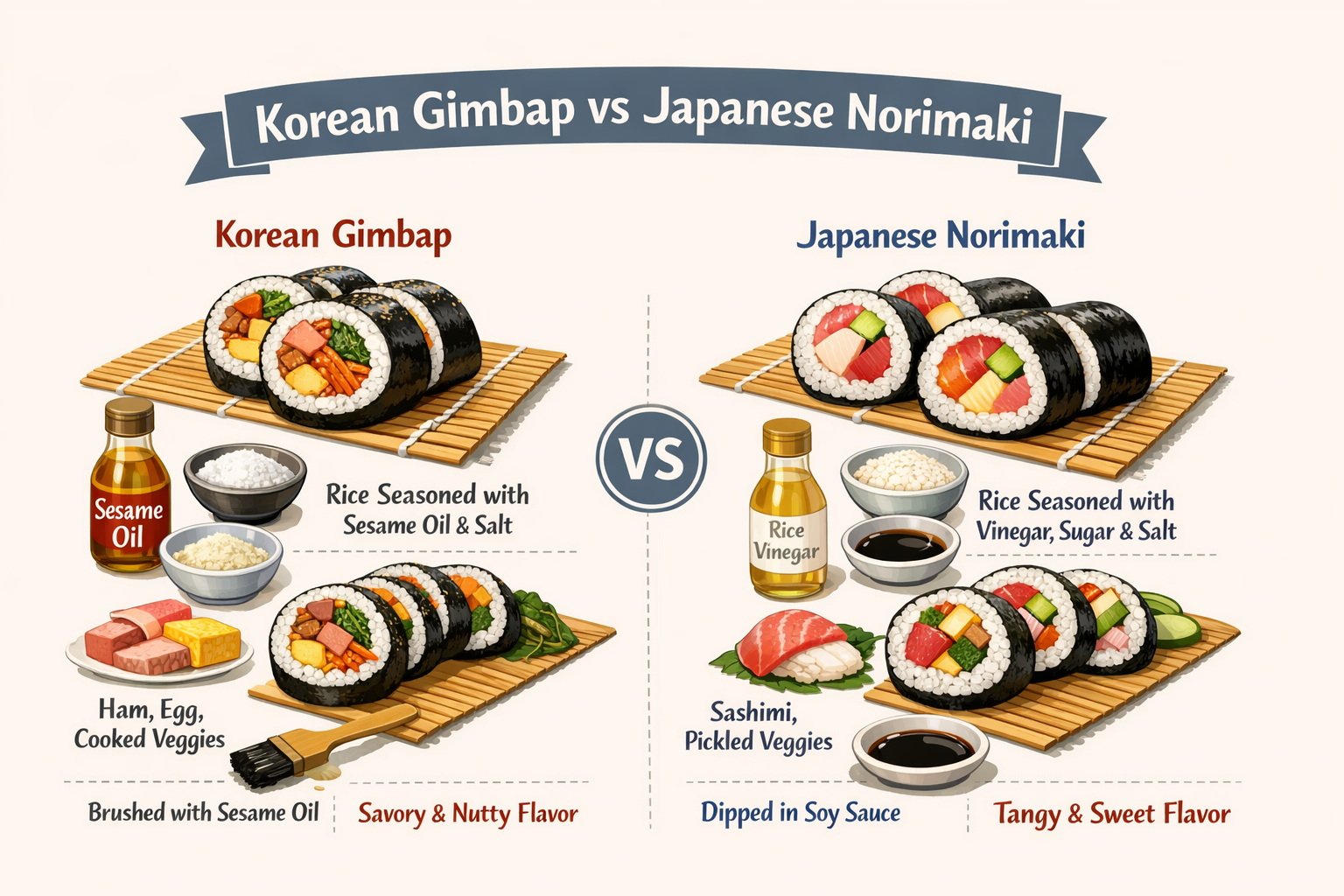
Despite their visual similarities, gimbap and norimaki differ most significantly in how the rice is seasoned and what fillings are used.
Norimaki typically uses vinegared rice (sumeshi), giving it a bright, tangy flavor, whereas gimbap seasons its rice with sesame oil and salt. This seemingly small difference shifts the entire flavor profile: instead of acidity, gimbap emphasizes deep nuttiness and gentle savoriness. The aroma of sesame oil is especially central—it allows gimbap to remain flavorful even when eaten cold, reflecting a distinct direction in Korean taste culture.
The fillings also set the two apart. Korean gimbap commonly includes sautéed vegetables, ham, egg, burdock root, or pickled radish, while Japanese rolls often feature raw fish and pickled ingredients. Though both dishes share rice and seaweed as their foundation, they have evolved along different culinary paths shaped by local ingredients, cultural preferences, and historical change. For this reason, gimbap may be better understood not simply as a derivative of norimaki, but as a dish that settled into Korean food culture in its own way—much like how dishes such as jajangmyeon became uniquely Korean through adaptation and time.
Beyond its basic form, gimbap has evolved into many variations shaped by regional traditions and personal taste. Among the most widely recognized are Kkoma Gimbap—literally meaning “mini gimbap”—and Chungmu Gimbap.
Kkoma Gimbap is smaller than standard rolls and usually contains fewer fillings. Commonly sold at casual Korean snack shops, its bite-sized shape makes it easy to enjoy alongside dishes like tteokbokki or ramen. The fillings are often simple—sometimes just spicy fish cake or bulgogi, and occasionally only rice and seaweed—typically served with a spicy dipping sauce.
In contrast, Chungmu Gimbap is a regional specialty from Tongyeong in South Gyeongsang Province. It was originally created for fishermen who needed a meal that could withstand the hot sun without spoiling quickly. Unlike most gimbap, it contains only plain rice wrapped in seaweed, while strongly seasoned side dishes such as spicy squid, fish cake, and radish kimchi are served separately. The bold seasoning with chili flakes, garlic, and vinegar adds flavor while helping preserve freshness.
In this way, gimbap continues to evolve while maintaining its core form, reflecting regional character, ingredient choices, and diverse culinary traditions across Korea.

While writing this article, a scene from my childhood came back to me.
On mornings when I overslept and rushed to get ready for school, my mother would quickly place rice and side dishes onto a small piece of seaweed, roughly wrap it, and gently feed me a single bite.
Looking back now, that fleeting memory feels less like a carefully crafted dish and more like the spirit of boksam—the long-standing tradition of wrapping food with care while wishing for good fortune.
Perhaps our childhood memories of gimbap become small moments of comfort, quietly healing us whenever we long for a simple meal in the middle of busy, exhausting days. It may also explain why the humble gimbap and ramen eaten by the characters in K-Pop Demon Hunters sparked curiosity among viewers around the world.
Even if the form differs, the memory of a “simple yet warm meal” prepared by someone who cares carries a universal emotional thread that people everywhere can understand.